SonicWall Secure Check: What the New AI Firewall Configuration Review Means for Health Care IT
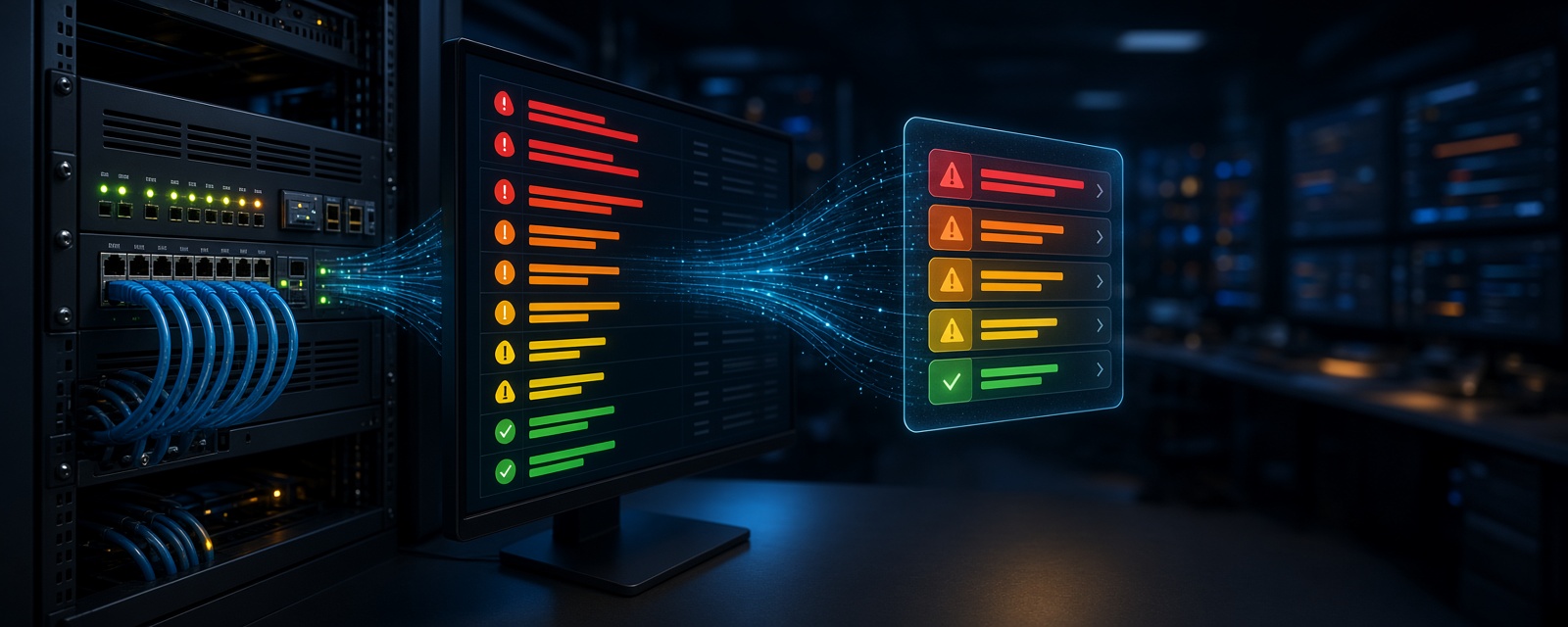
SonicWall has a new AI-assisted service for its channel partners that reviews firewall configurations and returns a ranked list of what to fix. It is called Secure Check. According to Channel Insider's November 16, 2026 report, it evaluates a firewall configuration against security best practices and prioritizes the recommended changes by severity: critical, high, medium, or low.
If your organization runs SonicWall firewalls, or an MSP runs them for you, this is worth knowing about. Firewall configurations drift. A rule gets opened for a vendor's remote support session and never closed. A VPN setting made sense three hardware generations ago. An old address object still points at a server that was retired years ago. Secure Check is SonicWall's attempt to catch that drift faster. It is also a partner-delivered service with very little public detail so far, and its output still needs a qualified person to review it. Below is what is known, what is not, and how to get real value from it if it is available to you.
At a glance
What it is: An AI-driven configuration assessment for SonicWall firewalls, delivered through SonicWall channel partners.
Who can get it: Reported as available to partners with "Gen 8 upgrades." Specific models, firmware, and pricing have not been published.
What you get: Findings ranked critical, high, medium, or low, remediation guidance, and a technical walkthrough of about 30 minutes.
What to do, in order:
- Ask your SonicWall partner or MSP whether your firewalls qualify and what it costs.
- If they do, request an assessment and put the person who owns the firewall in the walkthrough.
- Verify every critical and high finding against the live configuration before changing anything.
- Document what you changed, what you did not, and why, and fold it into your risk analysis and risk management records.
How Secure Check works
Secure Check takes one of two inputs, per Channel Insider. The first is a technical support report (TSR) supplied by the partner. The second is Security Insights data from SonicWall's Network Security Manager (NSM), the vendor's centralized management platform. The AI analysis compares the configuration against security best practices. It then produces findings ranked by severity, along with guidance on what to change. Partners also get a technical walkthrough of roughly 30 minutes to go through the results.
Ryan Matlock, SonicWall's Chief Customer Success Officer (Channel Insider identifies him as VP of Customer Service), told Channel Insider that the analysis considers best practices and requirements commonly tied to cyber insurance coverage. He also said AI speeds up the analysis and a human then makes the decisions. The same report notes that SonicWall provides the analysis and recommendations, while implementation decisions stay with the organizations responsible for those environments. That division of labor matters. Secure Check tells you what it thinks is wrong. It does not change your firewall, and the accountability for what happens next stays with you and your partner.
The report also says the offering grew out of SonicWall's concern about outdated configurations, and that it gives partners an assessment they can use to show customers where improvements are needed, since customers may resist paying for added security work or downtime. The sources reviewed for this article do not describe a published procedure for requesting an assessment, so ask your SonicWall partner how to start one.
Who can actually get it
The only published eligibility language is that Secure Check is "available to partners with Gen 8 upgrades," as reported by Channel Insider and repeated in an MSSP Alert brief. That phrase is ambiguous. It could mean the firewall being assessed must be Gen 8 hardware, or it could describe which partners SonicWall is offering the service to. None of the available coverage lists supported models, firmware versions, or whether NSM is required. If you are running older SonicWall hardware, do not assume you qualify. Ask.
The other practical point is that this is a partner program. If you bought your SonicWall through a reseller or your firewalls are managed by an MSP, that partner is your path in. If you are not sure who your SonicWall partner of record is, your renewal paperwork or support portal is a good place to start looking.
A note on timing and sourcing. The Channel Insider piece, by Victoria Durgin, is the primary public report, and the MSSP Alert brief is based on it rather than being independent confirmation. No SonicWall press release or product page for Secure Check turned up during research for this article. November 16 is best read as the date of the coverage, not a confirmed launch date.
Why this matters in a health care environment
Nothing in SonicWall's reported materials says Secure Check was built for health care or mapped to HIPAA. The connection is ours, and we think it is a useful one. For most health care organizations, the perimeter firewall is one of the main technical controls standing between systems that hold electronic protected health information (ePHI) and the internet. Its configuration decides who gets in over VPN, what the EHR vendor's support connection can reach, and whether a flat network stays flat. A periodic, structured review of that configuration supports several things the Security Rule asks of you.
Under 45 CFR 164.308(a)(1)(ii)(A), risk analysis (Required) calls for an accurate and thorough assessment of potential risks and vulnerabilities to the confidentiality, integrity, and availability of ePHI. Under 45 CFR 164.308(a)(1)(ii)(B), risk management (Required) calls for security measures sufficient to reduce those risks and vulnerabilities to a reasonable and appropriate level. The evaluation standard at 45 CFR 164.308(a)(8) requires periodic technical and nontechnical evaluation, including in response to environmental or operational changes affecting the security of ePHI. A firewall configuration that has drifted since its last review is exactly that kind of change.
The technical safeguards are relevant too. The access control standard at 45 CFR 164.312(a)(1) calls for technical policies and procedures that allow access to systems maintaining ePHI only to persons or software programs that have been granted access rights. The transmission security standard at 45 CFR 164.312(e)(1) calls for technical security measures to guard against unauthorized access to ePHI transmitted over an electronic communications network. Its encryption implementation specification, 45 CFR 164.312(e)(2)(ii), is Addressable. Addressable does not mean optional. It means you implement the specification or document why an equivalent alternative is reasonable and appropriate. Firewall rules and VPN settings are part of how many organizations meet both standards.
Here is the caution. A clean Secure Check report is not a HIPAA risk analysis and is not evidence of compliance on its own. By SonicWall's own description, it checks against security best practices and insurance-related requirements, not against the Security Rule. It covers one device class. Use it as one input to your risk analysis, not as a substitute for one.
Consider a realistic case: a 25-bed Critical Access Hospital with one IT generalist, a SonicWall firewall at the main campus, a site-to-site VPN to an affiliated rural health clinic, and an MSP that manages the firewall. Nobody has looked at the full rule set since the last hardware refresh. For that organization, a ranked list of findings with a walkthrough is a reasonable way to get a structured review done without blocking out a week. The value comes from what happens afterward: someone verifies the findings, schedules the changes, and writes down the decisions.
What to watch for
AI output still needs verification. The service is new, and there is no independent data yet on its accuracy or false-positive rate. SonicWall itself frames the AI as a way to speed up analysis, with a human making the decisions. Hold it to that. Before you remove a rule flagged as unnecessary, confirm what depends on it. In health care, the rule that looks unused may be the one carrying an interface feed, a lab instrument connection, or a vendor's after-hours support path.
Your configuration is sensitive data. A TSR is a detailed snapshot of the firewall, and a firewall configuration is effectively a map of your network. Ask where the report goes, who can see it, how long it is kept, and whether anything in it could contain information your organization considers protected. Your partner should be able to answer those questions plainly. No SonicWall documentation on TSR contents or handling was located for this article.
Expect a conversation about services. Per Channel Insider, Matlock pointed to SonicWall's managed services as an option for partners that lack resources for continuous oversight, and the assessment is positioned as a way for partners to show customers where improvements are needed. That is not a knock on the tool. It is a reason to evaluate any follow-on offer on its own merits, separately from the findings.
A point-in-time review is not change control. An assessment tells you where you stand today. It does not stop the next undocumented rule from being added next month. Pair it with a basic change log for the firewall and a recurring review schedule.
You are not locked into one approach. Configuration review is not unique to SonicWall. Independent assessors and third-party configuration analysis tools exist, and a manual rule-by-rule review on a set schedule costs nothing but staff time. If you do not qualify for Secure Check, or you want a second opinion, those remain valid options.
Questions to ask your partner
- Do our specific firewalls qualify, and what does "Gen 8 upgrades" mean in our case?
- Is there a cost, or is it included in an existing agreement?
- Will you use a TSR or NSM Security Insights, and how is that data handled and retained?
- Will we receive the written findings, not just the walkthrough?
- Who makes the changes, in what maintenance window, and what is the rollback plan?
- Can the assessment be repeated after remediation or on a recurring schedule?
Turning findings into documented action
If you get a report, work it in a way that will hold up later.
- Back up the current firewall configuration before touching anything, and confirm you can restore it.
- Verify each critical and high finding against the live configuration, and identify what traffic or system each affected rule supports.
- Make changes in a scheduled window with a rollback plan. Test clinical systems, remote access, and vendor connections afterward.
- Document every finding and its outcome, including the ones you chose not to act on and the reason. That record belongs with your risk management documentation.
- Rerun the assessment, or a manual review, after significant network changes and on a regular schedule.
What we still do not know
Public information is thin, and no official SonicWall documentation, press release, or product page for Secure Check has been located as of November 18, 2026. Pricing and licensing have not been published. Supported models and firmware have not been listed beyond the "Gen 8 upgrades" language. It is not clear how much more the NSM path offers compared with a TSR on its own, or how a partner or customer formally requests an assessment. There is no independent review of the findings' accuracy, and there is no word on whether the service will extend beyond partners or to older hardware. We will update our coverage as SonicWall publishes official documentation or as practitioners report real-world results.
This article is for informational purposes only and does not constitute legal or compliance advice. Covered entities and business associates should consult qualified legal counsel or compliance professionals before making decisions pertaining to HIPAA or IT infrastructure.
Sources
- Channel Insider, Victoria Durgin, "SonicWall Launches AI-Powered Firewall Security Check," November 16, 2026: https://www.channelinsider.com/security/sonicwall-secure-check-ai-firewall/
- MSSP Alert, "SonicWall Introduces AI-Driven Firewall Assessment Tool" (brief based on Channel Insider reporting): https://www.msspalert.com/brief/sonicwall-introduces-ai-driven-firewall-assessment-tool
- SonicWall, Ryan Matlock leadership page: https://www.sonicwall.com/leadership/ryan-matlock
- Electronic Code of Federal Regulations, 45 CFR Part 164 (164.308 Administrative safeguards; 164.312 Technical safeguards): https://www.ecfr.gov/current/title-45/subtitle-A/subchapter-C/part-164