


Free Help or Hidden Threat? Microsoft's Free Rural Hospital Cybersecurity Program and the SonicWall Cloud Backup Breach: Two Stories Every CAH IT Director Needs to Act On in 2026
I. Two Conversations Happening Right Now
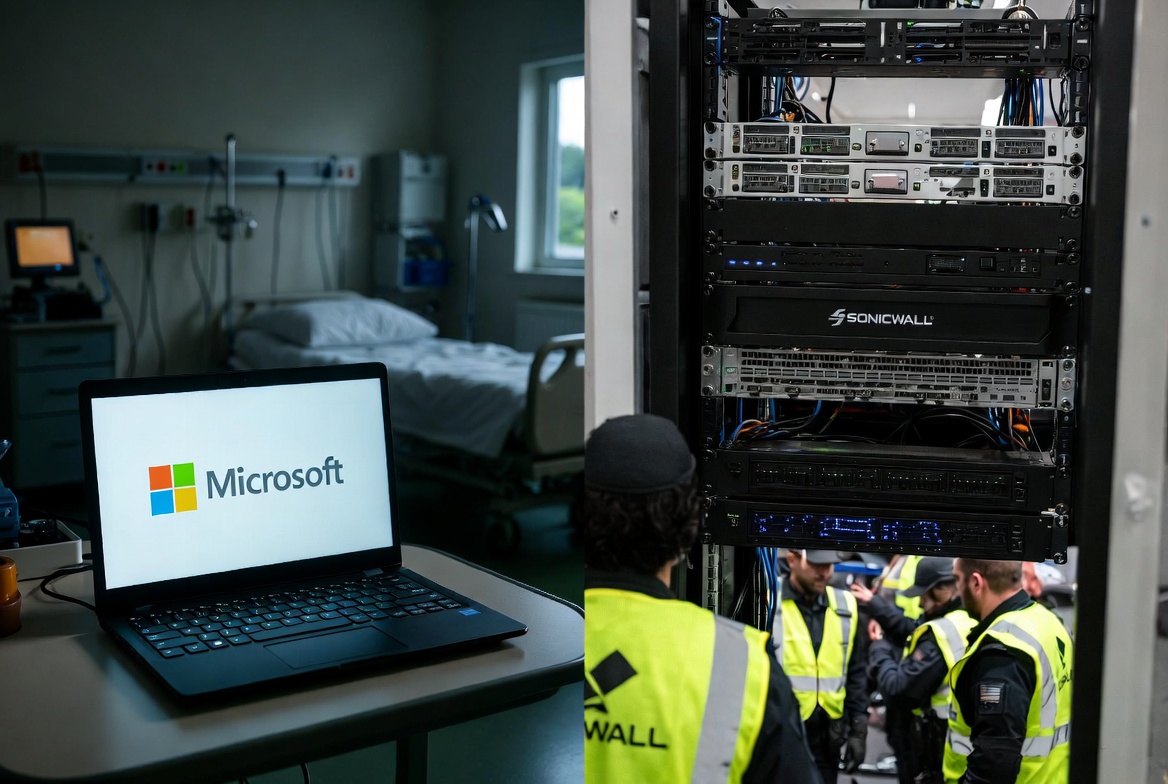
Somewhere in rural America this week, a Critical Access Hospital IT director is on a call with a Microsoft partner scheduling a free cybersecurity assessment. Her 15-bed hospital has been enrolled in the Rural Health Resiliency Program for six months. She just found out she can extend Windows 10 support on 180 devices for free through October 2026 -- buying time for a Windows 11 migration she could not previously afford. She has never had access to a vetted outside security firm. She is getting one at no cost.
At the same hospital, or one very much like it, another IT director is quietly rotating credentials on a SonicWall firewall. He got the alert: all MySonicWall cloud backup customers had their firewall configuration files exfiltrated in a breach that SonicWall initially said affected fewer than 5 percent of customers. Then updated to 100 percent. The files contained his VPN configuration, admin credentials, network rules, and unencrypted MFA scratch codes. The same type of data that enabled a ransomware attack on Marquis Software Solutions in August 2025 -- a breach that exposed the personal and financial records of more than 672,000 people across 74 banks and credit unions.
These two stories are not coincidental neighbors in a news feed. They are the 2026 rural health IT reality in compressed form: free, targeted help is available from a major technology partner, while simultaneously, the vendor infrastructure that rural hospitals depend on for cost-effective perimeter security has demonstrated that supply-chain breaches reach downstream with devastating consequences -- even when the target has MFA enabled and a fully patched firewall.
This article covers both in full -- what Microsoft is actually offering, who qualifies, how to enroll, and what to do right now if SonicWall is in your environment.
II. Side-by-Side: Opportunity vs. Risk
The following table maps both stories across the dimensions most relevant to CAH IT directors and compliance officers. Green columns indicate opportunity; red indicates documented risk.
| Dimension | Microsoft Rural Program (Opportunity) | SonicWall Cloud Backup Breach (Risk) | HIPAA Implication |
| What Happened | June 2024 launch; 700+ rural hospitals enrolled by late 2025; free assessments, training, and Windows 10 ESU through Oct 2026 | Feb 2025 API change created unauthenticated access to all cloud-stored firewall config backups; detected Sep 2025; confirmed 100% impacted in Oct 2025 | Both events trigger Sec. 164.308(a)(1) risk analysis obligations -- one proactively, one reactively |
| Who Is Affected | ~2,000 U.S. rural hospitals; CAHs, REHs, Rural Community Hospitals; must be listed in the Urban & Rural Hospitals database | All MySonicWall cloud backup customers; SonicWall is widely deployed in rural and mid-size healthcare for cost-effective perimeter security | Rural hospitals face both simultaneously -- an enrollment opportunity and an active vendor audit obligation |
| Cost | Free (assessments, training, Windows 10 ESU); 60-75% off Microsoft security products for qualifying CAHs and REHs | Marquis breach: 672,000+ individual records exposed; 36+ consumer class actions against Marquis; $millions in notification, forensic, and remediation costs | Microsoft savings can fund the credential rotation and segmentation work SonicWall incident demands |
| Action Required | Enroll at nonprofits.tsi.microsoft.com -- takes minutes; verify rural status first at ruralhospitals.chqpr.org | If using SonicWall cloud backup: rotate ALL credentials immediately; disable cloud backup if unused; audit access logs; document in risk analysis | Both actions map to Sec. 164.308(a)(1) risk analysis and Sec. 164.308(a)(7) contingency planning |
| Timeline | Windows 10 ESU expires October 13, 2026 -- enroll before then to access free licenses | Vulnerability introduced Feb 2025; attack on Marquis Aug 14, 2025; SonicWall disclosure Sep 2025; lawsuit filed Feb 2026; litigation ongoing | Breach notification clock (Sec. 164.404) runs from date organization confirms PHI was accessible via compromised network path |
| IMPORTANT: These two stories are not mutually exclusive. Many rural hospitals running SonicWall firewalls are also eligible for the Microsoft program. The enrollment action and the credential rotation action are both urgent, both free, and both actionable this week. |
III. The Microsoft Rural Health Resiliency Program: What Is Actually Included
Background and Scale
Microsoft launched the Cybersecurity Program for Rural Hospitals in June 2024 in partnership with the American Hospital Association (AHA) and National Rural Health Association (NRHA). The stated mission: close the cybersecurity gap that threatens patient access for 46 million Americans living in rural communities.
The scale of the problem the program addresses is documented. Rural hospitals typically spend 4 to 7 percent of their IT budgets on security, compared to 15 percent in financial services. When a rural hospital experiences a ransomware attack, patients must travel more than twice as far as urban residents to reach the nearest alternative facility -- often 20 additional miles for common services and 40 additional miles for specialized care.
Program growth: By March 2025, 550 rural hospitals had enrolled with 375 assessments completed and more than 1,000 staff trained. By late 2025, a Microsoft executive confirmed more than 700 rural hospitals participating -- more than one-third of all rural hospitals in the United States, and the number continues to grow.
Eligibility -- Who Qualifies
Eligibility is broad and the verification process is simple. The key requirement: the hospital must be listed as "rural" in the Urban and Rural Hospitals database maintained at ruralhospitals.chqpr.org.
All hospitals designated "rural" in the Urban and Rural Hospitals database
Independent Critical Access Hospitals (CAHs) -- all qualify
Rural Emergency Hospitals (REHs) -- all qualify
Rural Community Hospitals -- qualify based on database listing
Health system hospitals: only the specific hospital locations listed as "rural" in the database qualify; the health system as a whole does not
Ineligible: urban hospitals, health plans, ambulatory or outpatient-only facilities, non-U.S. facilities.
| ENROLLMENT: Register at nonprofits.tsi.microsoft.com/security-program-for-rural-hospitals or search 'Microsoft Rural Health Resiliency Program.' Verify your hospital's rural status first at ruralhospitals.chqpr.org. Enrollment is free and takes approximately 10 minutes. |
Full Offerings -- Verified as of March 2026
| Offering | Who Qualifies / Details | How to Access |
| Free Cybersecurity Assessment | All enrolled rural hospitals; vetted Microsoft partner conducts the assessment; no purchase required | Register at nonprofits.tsi.microsoft.com; email RuralHealth@microsoft.com after enrollment |
| Free Cloud & AI Readiness Assessment | All enrolled rural hospitals; roadmap for shifting legacy infrastructure to cloud; no purchase required | Email RuralHealth@microsoft.com after registering for the program |
| Windows 10 ESU -- FREE through Oct 13, 2026 | ALL rural hospitals; up to 250 devices; must be on final version (22H2); EXPIRES Oct 13, 2026 | Register for the Rural Health Resiliency Program; Windows 10 ESU activates automatically post-enrollment |
| Cyber Awareness Training | All enrolled rural hospitals; frontline staff pathway + foundational cyber risk management certification for IT staff | Available via curated learning pathways after enrollment; free, self-paced |
| Microsoft Security Products (60-75% off) | Independent CAHs and Rural Emergency Hospitals only; M365 E5 Security, EMS E3, and more | Nonprofit pricing via the enrollment portal; requires independent hospital status (health system hospitals do not qualify) |
| AI Claims Denial Navigator (free) | All enrolled rural hospitals; AI-powered tool for resolving denied Medicare, Medicaid, and commercial insurance claims | Download free on GitHub after program registration |
| Rural Health AI Innovation Lab (RHAIL) | Collaborative cohorts; rural hospitals help co-create AI tools for workflow automation and clinical efficiency | Apply through the program portal; cohorts ongoing |
One offering warrants specific urgency: the Windows 10 Extended Security Update. Windows 10 mainstream support ended in October 2025. Many rural hospitals are still running Windows 10 on devices they cannot immediately upgrade. The Microsoft program provides free ESU licenses for up to 250 devices per hospital through October 13, 2026 -- but devices must be running the final Windows 10 version (22H2) to qualify. If your hospital has not enrolled and has Windows 10 devices, this is a time-sensitive action.
Real-World Savings
One rural hospital reported $36,000 in annual savings and $425,000 over three years through the program's standardization support and nonprofit pricing. For a CAH with a total IT budget measured in the low hundreds of thousands, that reallocation is material. Redirecting even a portion of those savings into MFA enforcement and offline backup infrastructure directly addresses the vulnerability class the SonicWall incident exposed.
IV. The SonicWall MySonicWall Breach: What Actually Happened
The Root Cause
SonicWall is widely deployed in rural and mid-size healthcare settings as a cost-effective perimeter firewall. The MySonicWall platform allows customers to back up firewall configuration files to SonicWall's cloud -- a convenience feature that stores VPN configurations, network access rules, service credentials, admin usernames and passwords, and MFA scratch codes.
In February 2025, SonicWall introduced a change to one of its APIs in the MySonicWall cloud backup service. According to the Marquis lawsuit complaint, that change created a vulnerability that allowed attackers to download any customer's firewall configuration backup file without authentication, simply by guessing predictable device serial numbers. There was no brute-force protection on the serial number lookup. The files were not fully encrypted -- specifically, MFA scratch codes were stored in plaintext.
| WHAT WAS IN THE FILES: Each stolen configuration backup contained: AES-256 encrypted admin credentials; VPN user accounts and authentication settings; network rules and firewall policies; SSL certificates; LDAP and RADIUS server credentials; and -- critically -- unencrypted MFA scratch codes that allow one-time bypass of multi-factor authentication. Possessing these files is functionally equivalent to having a blueprint of the target network and a set of master keys to the front door. |
The Disclosure Timeline and Marquis Cascade
| Date | Event | Significance |
| Feb 2025 | SonicWall introduces API code change to MySonicWall cloud backup service | Change allows unauthenticated download of firewall config backups by guessing predictable device serial numbers. No authentication required. Attackers begin exploiting immediately. |
| Aug 14, 2025 | Ransomware attack on Marquis Software Solutions | Attackers use stolen SonicWall config files to bypass Marquis's firewall -- despite MFA being enabled and the firewall being fully patched. 74+ banks and credit unions affected downstream. |
| Sep 17, 2025 | SonicWall discloses breach -- initial claim: fewer than 5% of customers affected | SonicWall advises password resets. Warns stolen files could allow attackers to compromise customer firewalls. Initial scope significantly understated. |
| Oct 2025 | SonicWall update: ALL cloud backup customers were affected | Post-Mandiant investigation confirms 100% scope. Stolen files included AES-256 encrypted credentials, VPN configs, firewall rules, and unencrypted MFA scratch codes. |
| Dec 2025 | Marquis begins notifying affected bank customers | At least 400,000 individuals notified initially; number rises as state AG filings accumulate. Latest confirmed count: 672,000+. |
| Feb 23, 2026 | Marquis files lawsuit against SonicWall in U.S. District Court, Eastern District of Texas | 35-page complaint alleges gross negligence: predictable serial numbers, unencrypted MFA scratch codes, failure to detect unauthorized access for months, misrepresentation of initial scope. 36+ consumer class actions now pending against Marquis. |
| Mar 2026 | SonicWall disputes connection; litigation ongoing | SonicWall states it has not identified technical evidence establishing a link between the cloud backup incident and the Marquis ransomware attack. Dispute is active. |
| STATUS AS OF MARCH 23, 2026: Active litigation. SonicWall disputes the connection. If you use SonicWall cloud backup, treat your credentials, VPN configs, and network architecture as potentially known to a threat actor until you have completed a full credential rotation and access audit. | ||
Why This Matters to Healthcare Organizations
SonicWall disputes the causal connection between its cloud backup breach and the Marquis ransomware attack. That dispute is being litigated. What is not disputed: SonicWall confirmed in October 2025 that all customers using the cloud backup feature had their configuration files exfiltrated. What is not disputed: those files contained credentials and MFA bypass codes. What is not disputed: Marquis was a SonicWall customer whose firewall was fully patched and MFA-enabled when it was compromised.
For healthcare organizations, the HIPAA implication is straightforward. If attackers used stolen SonicWall credentials to access a network that contained electronic PHI, that access constitutes an unauthorized disclosure -- regardless of whether data was confirmed exfiltrated. The burden of proof under HIPAA's breach notification rule (Sec. 164.404) runs the other direction: the covered entity must demonstrate that PHI was not acquired or accessed, not that it was.
SonicWall is common in rural and mid-size healthcare specifically because it is cost-effective. That same cost-effectiveness means it is disproportionately deployed in organizations with limited security monitoring -- organizations less likely to have detected anomalous access during the window between February 2025 and September 2025.
V. HIPAA Compliance Matrix
The following table maps both stories to the specific HIPAA Security Rule provisions they implicate. Use it as a starting point for your next risk analysis update.
| HIPAA Provision | Microsoft Program Helps With... | SonicWall Incident Triggers... |
| Sec. 164.308(a)(1) -- Risk Analysis | Free cybersecurity assessment from a vetted firm provides the documented risk analysis CAHs often lack; directly satisfies the requirement to identify and assess risks to ePHI confidentiality | Compromised firewall configs expose the network path to ePHI systems; if PHI was accessible via the compromised path, a breach notification analysis is required regardless of whether data was confirmed exfiltrated |
| Sec. 164.308(a)(7) -- Contingency Planning | Free cloud readiness assessment and training pathways support disaster recovery planning; Windows 10 ESU extension prevents security gaps during transition to supported OS | Stolen VPN credentials and firewall rules effectively give attackers the ability to disable or circumvent the perimeter during a future attack; contingency plans must account for this exposure window |
| Sec. 164.308(b) -- Business Associate Agreements | Microsoft's program participation does not create a new BAA requirement; existing Microsoft product BAAs apply to M365 and Azure services used for clinical data | SonicWall is a business associate if it processes or maintains ePHI-adjacent network infrastructure; review your BAA with SonicWall and confirm whether the breach triggers BAA notification obligations |
| Sec. 164.404 -- Breach Notification (60-Day Clock) | Not directly applicable to the Microsoft program; however, assessments may uncover prior undisclosed incidents that trigger notification obligations | If forensic review confirms that attackers used stolen SonicWall configs to access systems containing PHI, the 60-day notification clock runs from the date of discovery -- not from SonicWall's September 2025 disclosure |
| Sec. 164.530(b) -- Workforce Training | Free cyber awareness training pathways for frontline staff and IT certification pathways directly satisfy the workforce training obligation for rural hospitals with no training budget | Staff must be trained on supply-chain attack indicators: unusual login patterns, unfamiliar VPN connections, new admin accounts -- the specific vectors the SonicWall-derived attack would use |
VI. 2026 Action Roadmap for CAHs and Rural Providers
The following checklist integrates both stories into a single prioritized action plan. Green rows are Microsoft program actions -- opportunity to capture. Red rows are SonicWall actions -- risk to mitigate. White rows apply to both.
| Type | Action | How to Execute | Timeline |
| Microsoft | Verify rural status and enroll in the Rural Health Resiliency Program | Confirm hospital is listed at ruralhospitals.chqpr.org; register at nonprofits.tsi.microsoft.com. Takes 10 minutes. | TODAY |
| SonicWall | Reset ALL credentials on SonicWall devices -- admin passwords, VPN user accounts, service accounts, LDAP/RADIUS credentials | Log into each SonicWall management interface; reset every credential stored in the config file; do not reuse previous passwords | TODAY |
| SonicWall | Disable MySonicWall cloud backup if not actively required | Management console > System > Cloud Backup; disable if not needed. If required operationally, review what data is stored and confirm encryption settings. | TODAY |
| Microsoft | Schedule free cybersecurity assessment through the program | After enrollment, email RuralHealth@microsoft.com to schedule; vetted firm conducts the assessment; no cost, no purchase required | 30 DAYS |
| SonicWall | Audit access logs for anomalous VPN connections or admin logins since February 2025 | Review SonicWall syslog for login attempts using credentials stored in config files; look for new admin accounts, unusual geographic logins, or lateral movement patterns post-August 2025 | 30 DAYS |
| Both | Document SonicWall incident and Microsoft program enrollment in your HIPAA risk analysis | Both events are material to Sec. 164.308(a)(1). The SonicWall incident is a documented vendor supply-chain risk. Microsoft enrollment demonstrates proactive risk mitigation. | 30 DAYS |
| SonicWall | Review BAA with SonicWall; confirm breach notification obligations | Determine whether SonicWall qualifies as a business associate under your specific configuration; confirm whether the Sep 2025 disclosure triggers your BAA's notification requirements | 30 DAYS |
| Microsoft | Enroll all IT staff in free cyber certification pathways; schedule frontline cyber awareness training | Microsoft curated learning paths are free post-enrollment; satisfies Sec. 164.530(b) workforce training obligation; prioritize supply-chain attack indicators in training content | 60 DAYS |
| Both | Review cyber insurance for vendor-induced breach and downstream notification cost coverage | The Marquis situation documents exactly what an uninsured vendor-induced incident costs: forensics, ransom negotiation, legal defense, 36+ class actions, and notification for 672,000+ individuals | 60 DAYS |
| Microsoft | Redirect Microsoft discount savings into MFA on all admin interfaces and tested offline backups | The SonicWall incident demonstrates that even MFA can be bypassed with stolen scratch codes. Offline, air-gapped backups not reachable through a compromised firewall are the only reliable recovery path. | 90 DAYS |
| BUDGET NOTE: The Microsoft program's 60-75% discount on security products creates a concrete funding path for the SonicWall mitigation work. Savings on M365 E5 Security or EMS E3 licensing can fund the credential rotation effort, external log review, and network segmentation improvements the SonicWall incident demands. Run both conversations in the same budget cycle. |
VII. Looking Ahead
More Vendor Programs Are Coming
The Microsoft Rural Health Resiliency Program was the first major technology vendor program specifically targeting rural hospital cybersecurity at no cost. It is unlikely to be the last. The AHA and NRHA are actively working with multiple vendors to develop similar offerings, and the political pressure from rural hospital closures and ransomware-related care disruptions is creating incentive for additional corporate commitments. CAH IT directors who engage with the Microsoft program now are building the vendor relationship and the documented compliance baseline that will make them better positioned to participate in future offerings.
Supply-Chain Rulemaking Signals
The SonicWall-Marquis chain of causation is exactly the scenario that proposed updates to the HIPAA Security Rule are targeting. The May 2026 finalization target for the updated Security Rule includes explicit provisions addressing vendor and supply-chain risk -- requiring more rigorous due diligence on business associates and subcontractors, more specific documentation of third-party access controls, and shorter timeframes for breach notification when vendor incidents are involved. Organizations that have not yet formalized their vendor risk management programs face the possibility of being explicitly out of compliance when that rule takes effect.
The Next SonicWall
SonicWall is not unique. The pattern -- a convenience cloud feature in a widely deployed security product creates an unauthenticated access path to customer credentials -- will repeat with other vendors. The principle for rural health IT is the same in every iteration: any cloud-managed feature of a perimeter security device that stores network credentials or configuration data should be treated as a high-value target and audited with the same rigor as the device itself. If a cloud backup feature is not actively required for operations, it should be disabled. If it is required, the stored data should be inventoried and the vendor's encryption and access control practices should be documented in your risk analysis.
VIII. Conclusion
Rural hospitals operate in a cybersecurity environment where the gap between what they face and what they can afford has historically been the widest in the healthcare sector. Two 2026 developments pull in opposite directions on that gap.
Microsoft's Rural Health Resiliency Program is pulling it closed. Free assessments, free training, free Windows 10 ESU, and deeply discounted security products are available right now to more than one-third of U.S. rural hospitals. The enrollment takes ten minutes. The CAH IT directors and compliance officers who have not enrolled are leaving real money and real risk mitigation on the table.
The SonicWall MySonicWall breach is pulling it open. A supply-chain incident at a widely deployed rural healthcare vendor has demonstrated that a fully patched, MFA-enabled firewall can be bypassed using configuration data stored in a cloud backup service -- with no authentication required to access it. The downstream consequence, a ransomware attack affecting 672,000 individuals and 74 financial institutions, documents exactly what that exposure costs.
The organizations best positioned in 2026 are those that treat both stories as action items in the same week: enroll in the Microsoft program today, rotate SonicWall credentials today, and use the savings from one to fund the remediation work required by the other.
| RESOURCES: Enroll: nonprofits.tsi.microsoft.com/security-program-for-rural-hospitals | Verify rural status: ruralhospitals.chqpr.org | AHA cybersecurity resources: aha.org/cybersecurity | SonicWall advisory: sonicwall.com/support/notices | OCR HIPAA vendor guidance: hhs.gov/hipaa | CISA: cisa.gov | FBI IC3 incident reporting: ic3.gov |
Published: March 23, 2026 | Audience: CAH IT Directors, Rural Health Compliance Officers, Rural Hospital Executives, Security Teams
This article is for informational purposes only and does not constitute legal advice. Details are based on publicly available sources, vendor disclosures, court filings, and regulatory guidance as of March 23, 2026. The SonicWall-Marquis connection is alleged in active litigation; SonicWall disputes the causal link. Verify all program eligibility and enrollment details directly with Microsoft before relying on them for planning purposes.